Exploration Pack 2
One of the things that I found most fascinating this week was the attitudes that the Europeans had towards the Chinese people and the Chinese empire early on in their contact with them. My understanding of the relationship was that it was always an imperialist, oppressive European presence against a victimized Chinese people, but the actual history is far more nuanced.
While the European powers certainly had the idea of extortion in mind in their trading relationship with the Chinese Empire, and were only concerned with acquiring goods and resources that could help them further their own power, it was not as simple as just marching in and taking what they wanted. China was also a powerful nation, and the Europeans were restricted to trading cities along its coast. The Chinese also had the advantage in that they needed nothing from the Europeans but money: the Europeans produced nothing that was of value or use to the Chinese that they could not make themselves, while the Europeans heavily relied on goods from East Asia.
China’s view towards the foreign nations on its doorstep was also not necessarily of invaders, but rather weaker, resource poor nations that required the wealth of China in order to survive. This can be seen in the Qianlong Emperor’s response to the British King George III, who sent China a series of requests that would have greatly expanded Britain’s power and influence over trade in the region. The Emperor refuses all the requests, referring to the “lonely remoteness” of Britain, in addition to calling it and all the Western states “barbarian nations.” This appears more to be an interaction between equal, or at least semi-equal nations, not a colonizer and a colonized nation.
In addition to China occupying more equal footing with the West in the earlier days of trade, Chinese culture was held in a higher regard by the West, at least for a time. The Jesuit missionaries that had ventured to East Asia took great care to integrate Confucianism into the Christianity they were spreading (although they were not accepting of Daoism and Buddhism) and Western Enlightenment philosophers looked at China as superior to the West philosophically and intellectually. It was only after disputes with the Christian authorities that the Jesuits began to tamp down on Chinese culture and tradition, but before this, there was a great sharing of tradition and syncretism between the two cultures. This can be seen most beautifully in the paintings of Giuseppe Castiglione, which marry Western realism with Chinese subject matter and landscapes.
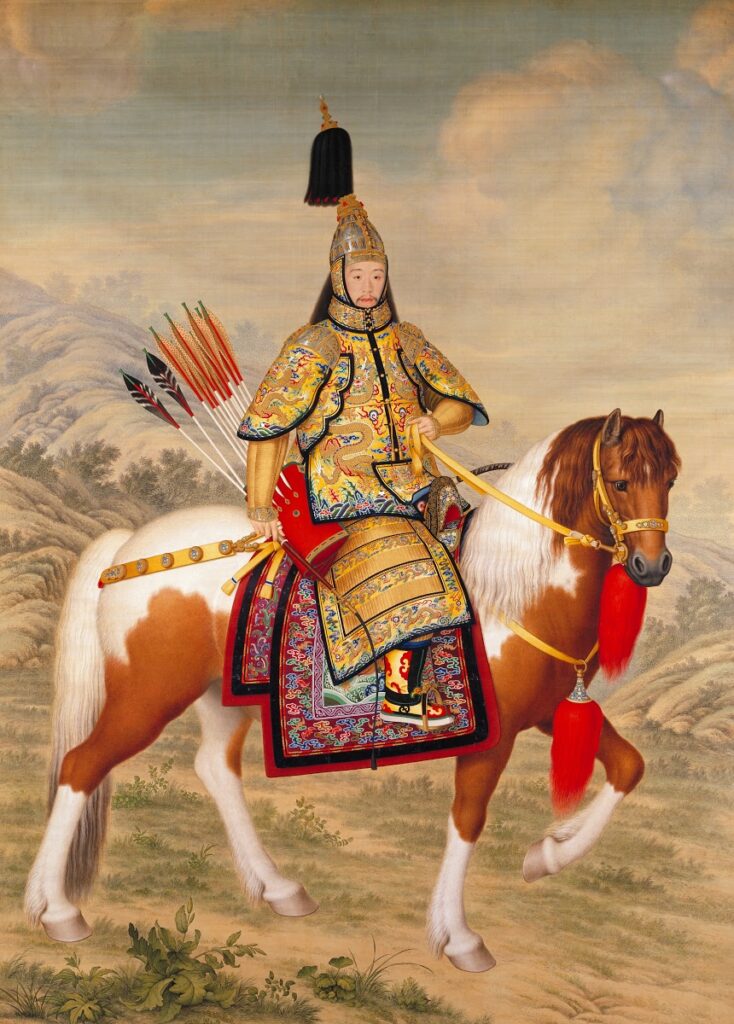
“The Qianlong Emperor in Ceremonial Armor on Horseback” Giuseppe Castiglione 1739
Works Consulted.
“6.5: The Second Edict [from Qianlong to King George], Sept. 1793”. In The Search for Modern China: A Documentary Collection, edited by Janet Y. Chen, Pei-kai Cheng, Michael Elliot Lestz, and Jonathan D Spence, 90-93. Third ed. New York: W.W. Norton & Company, 2014.
Mungello, David. “4. European Acceptance of Chinese Culture and Confucianism.” In The Great Encounter of China and The West, 1500 – 1800. Critical Issues in History. World and International History. Lanham, Md: Rowman and Littlefield, 2013.
