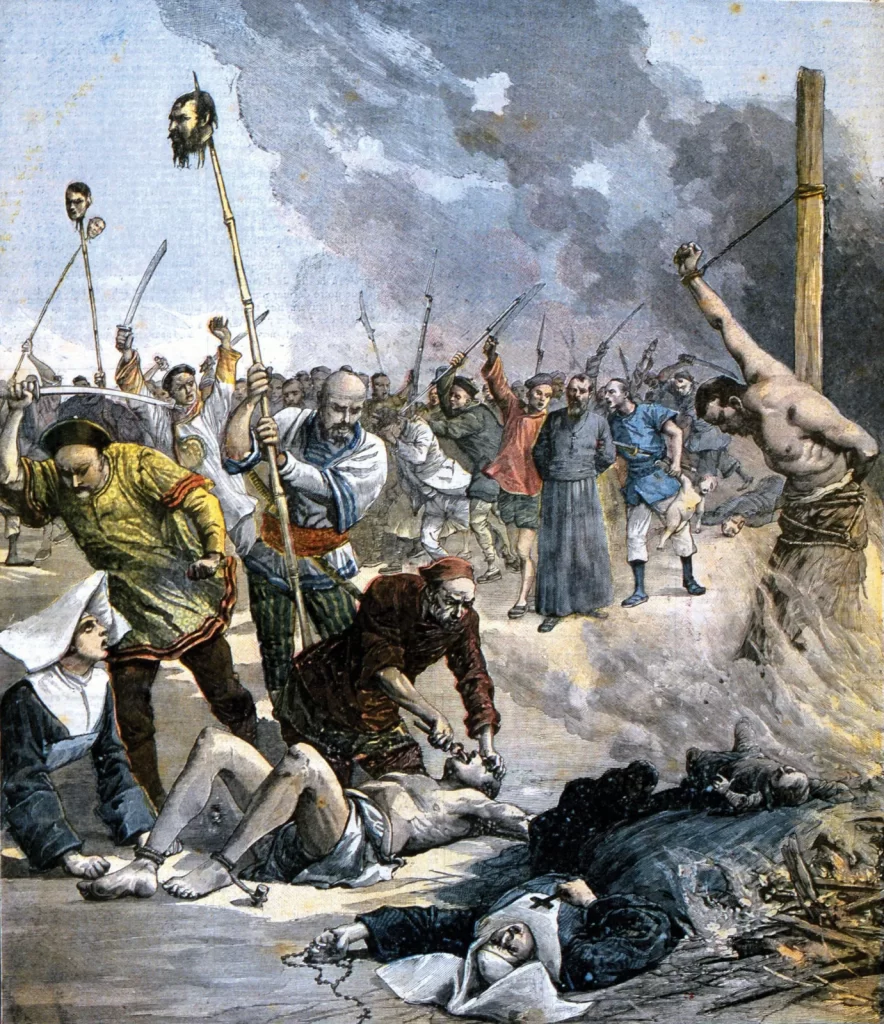
This week I focused mainly on the Boxer Rebellion and its characteristics, since it was the main event in the Basic Set this week. What I found most interesting about the Boxer Rebellion was the fact that it was not actually a Rebellion per se, rather this was a label applied to it by Western historians so as to not implicate the Qing dynasty. In reality the Dowager Empress supported and protected the Boxers due to her hatred of Western and Japanese influence upon China. It was technically a “rebellion” because the provincial governors in southern China gave their support to the West instead, and so fought against the Boxers.
The entire ideology of the Boxers was also interesting, both because they did not have any central leaders or command structure, and due to their iconoclasm. For a powerful nation like China to have fallen under the influence of so many foreign powers, it makes sense that the people who were most affected by the economic exploitation that came about as a result of dynastic instability and Western imperialism would take up arms. Physically destroying the means and monuments to Western domination while at the same time espousing traditional Chinese values and focusing on martial arts, the Boxers would probably have been a nightmare for the West had they been able to rally all of China to them.
As it was, the Boxer Rebellion gave the West and Japan the excuse they needed to storm in and carve China into pieces. I remember learning about the United States’ Open door policy in regards to China in American history classes, but was never really clear on what it was or how it worked. Moise’s book Modern China offered a much clearer view of the policy, especially the fact that it was not any sort of treaty but rather a passive agreement that nations with influence in China would not “exclude other nations from commerce” by means of their own imperialism. It also loosely prevented the division of China into colonies. I had always wondered why the West did not just divide China into colonies, and this class has offered some insights to that. China just seems to be too big to effectively split it, as well as the fact that, as weak as the Qing government may have been, it would have been even more difficult to break off entire provinces from the central government.
Works consulted
Edwin E. Moise. 2008. Modern China. Vol. 3rd ed. Harlow, England: Routledge. https://search.ebscohost.com/login.aspx?direct=true&db=nlebk&AN=634614&site=ehost-live&scope=site.
Melvin Bragg and guests “The Boxer Rebellion”. In Our Time, BBC Radio 4, March 19 2009.
