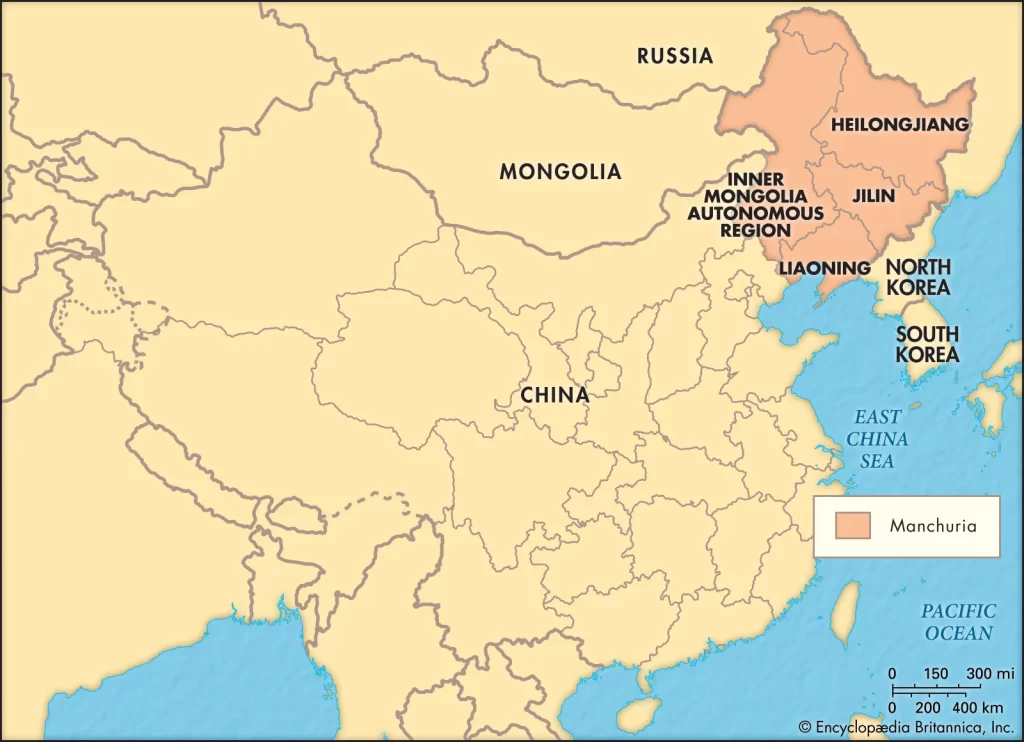
The Manchu conquest of the Ming dynasty was a result of a mixture of careful planning on the part of the Manchu, corruption and general degeneration of Ming rule and an inability to secure the borders of the empire, and military success on the part of the Manchu, which ushered in the dominion of a new dynasty: the Qing.
The Manchu were regarded, along with the other peoples that existed on the outer edges of the empire, as barbarians. In the eyes of the Ming, they were uncivilized and in many ways less than human. Their conquest of what was seen as a vastly superior culture was both humiliating and frightening. While the Manchu certainly did exercise ferocious tactics in their conquest of Ming China, notable the Yangzhou massacre, they were not simply an invading force of barbarians looking to plunder the country. Well-versed in Chinese ideas about rulership such as the Mandate of Heaven, the Manchu not only conquered China but also ruled it.
In part, the military success of the Manchu is thanks to their Eight Banner system, a system of military organization that allowed them to control their ranks from top to bottom. The origins of the system come from Nurhaci, who united the Manchu and divided all of the warriors that had pledged themselves to him into groups designated by different banners, all of which had different colors and designs which troops wore into battle. After Nurhaci, the banners were also divided by ethnicity, with Manchu, Mongol, and Chinese each getting their own specific banner within a specific company, meaning there were actually twenty-four total banners.
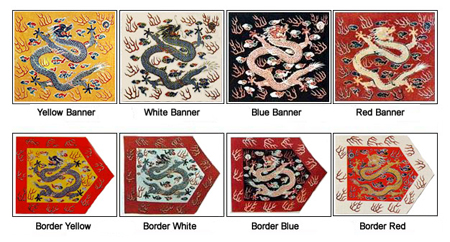
The nature of the Eight Banners made military organization and discipline far easier, and also made it easy for companies to distinguish each other on the battlefield. The fact that the companies were also divided along ethnic lines also allowed a degree of separation between the Manchu and the people they had conquered.
This was one of the many ways the Manchu enforced their rule upon the ethnic Han Chinese–the double-edged sword of separation along ethnic lines yet dominance and compulsory participation in the Manchu culture, at least on the part of men. The forcible wearing of the Manchu queue, what was very much a terrifying sight to Han Chinese on the battlefield, combined with the fact that soldiers now had to wear Manchu colors would have severely denigrated the Han and shown the superiority of the conquerers.
There was also another army, the Green Standard Army, which was far more numerous than the soldiers of the Eight Banners, but subordinated to the Manchu, as it was composed mostly of Ming troops and managed by Han Chinese officers. These two armies were also kept separate by the fact that the Green Standard Army defended the interior of China and the Eight Banners mostly garrisoned the borders.
Membership to a company of the Eight Banners was hereditary, and a source of considerable prestige (at least at the beginning of the Qing dynasty). The banner system was also important because it did not remain solely as a military system, but emerged as a societal structure as well. Membership to a banner was not only for a soldier, but also for his household, and it was a designation and distinction he held for life. This marriage of political and societal structure to military service is one of the things that made the Qing military so powerful and allowed to conquer a territory and population much larger than it. Its continued usage and expansion during Qing rule, particularly with its inclusion of other ethnic groups, reinforced Qing dominance and promoted the supremacy of its military.
Ultimately, the Qing dynasty was a military state, which, despite its smaller size, was able to outmaneuver and outperform the Ming dynasty on the field of battle. The Ming had lost much of its prestige, power, ability to control and pay its military, and its control over the more farflung provinces. For citizens of the empire, the prospect of being taken over by a “barbarian” people was terrifying, and in some cases the terror was very real. However, the Manchu exceeded the expectations of the ethnic Han Chinese in many ways due to their understanding of Chinese customs and their well-oiled military machine. The sight of a shaved forehead on the battlefield may have struck fear into the hearts of Imperial Chinese soldiers, but as the Qing incorporated them into their military-political system, they came to fight alongside them bearing the banners of their companies, and sporting the same queue that had caused Li Zicheng’s troops to flee in terror from Beijing when Wu Sangui and his Manchu allies attacked them.
Works consulted:
Lovell, Julia. The Great Wall: China against the World, 1000 BC-AD 2000. 1st paperback ed. New York: Grove Press, 2007.
Moll-Murata, Christine, and Ulrich Theobald. “Military Employment in Qing Dynasty China.” In Fighting for a Living: A Comparative Study of Military Labour 1500-2000, edited by Erik-Jan Zürcher, 353–92. Amsterdam University Press, 2013. http://www.jstor.org/stable/j.ctt6wp6pg.15.
